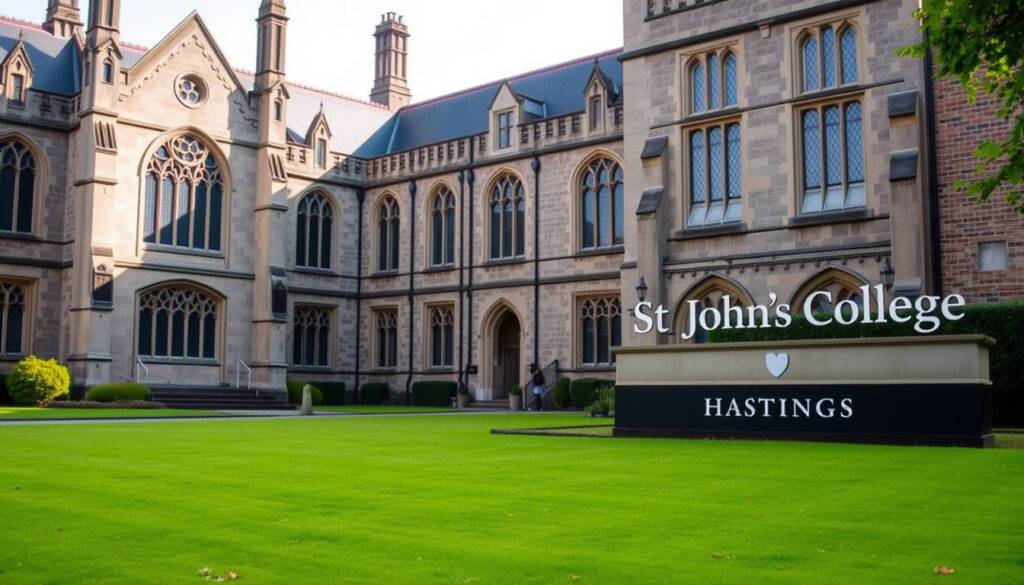
St John’s College Hastings: A Complete Parents Guide
Choosing the right secondary school for a son is one of those decisions where the details really matter — fees, uniform rules, how competitive entry actually is. St John’s College Hastings offers a state-integrated Catholic education for boys in Hawke’s Bay, and this guide breaks down the practical information from admission requirements and attendance dues to what the school day looks like.
School type: State Integrated Catholic Boys’ School ·
Location: Hastings, Hawke’s Bay, New Zealand ·
Student roll: 370 (Years 9-13) ·
Gender: Boys only ·
Category: Secondary school
Quick snapshot
- State integrated Catholic boys’ school, 370 students in Years 9-13 (St John’s College (Hastings) — official site)
- Uniform must be purchased from the school shop, open Wednesdays during term time (Parent Hub, St John’s College Hastings)
- Admission preference for Catholic students, open to non-Catholic if places available (school policy under Integration Agreement) (St John’s College (Hastings) — official site)
- Exact annual attendance dues vary yearly — check school website for current rates
- Most recent NCEA pass-rate breakdown from ERO not publicly available for latest year
- Founded 1950 by Marist Brothers; became state integrated in 1976 (school homepage)
- Current roll: 370 (2024); new buildings added in 2000s (school homepage)
- Ballot enrolment for 2025 intake typically opens mid-year — check school site for dates (Parent Hub)
- Year 9 uniform fitting happens in Term 3 holidays (Parent Hub)
Six facts define the school’s profile at a glance — one pattern worth noting is that the school operates as a state-integrated rather than private institution, which shapes everything from fees to admissions.
| Attribute | Value |
|---|---|
| School type | State Integrated Catholic Boys’ School |
| Year established | 1950 |
| Address | 410 Jervois Street, Hastings, 4120 |
| Phone | 06-8786853 |
| admin@stjohns.school.nz | |
| Principal | Mr. Michael Harding (as of 2024) |
Is St. John’s a private school?
School funding model: state integrated
- St John’s College is a state integrated school, not a private school — it receives government funding while retaining its Catholic character. Under New Zealand’s system, state integrated schools like this one operate under an Integration Agreement with the Crown, meaning the government covers staff salaries and operational costs, but the school charges “attendance dues” to maintain its special character (the school’s buildings, grounds, and religious facilities). According to the official school website, parents pay attendance dues (often called “fees”) but these are not private school tuition.
- The school homepage confirms its address at 410 Jervois Street, Hastings, and contact number 06 878 6853 — placing it firmly within the public schooling system by funding model, though with added costs for families.
Difference between private and state integrated in New Zealand
- Private schools in New Zealand receive no direct government funding for operating costs and charge full tuition fees. State integrated schools like St John’s College are former private or religious schools that joined the state system under the Private Schools Conditional Integration Act 1975. The government pays for teachers and curriculum delivery; the school board sets attendance dues to cover property and special character costs. The Ministry of Education’s guidance makes clear that attendance dues are compulsory for all students enrolled in state integrated schools, not optional donations.
The distinction: for a Hastings family comparing costs, the key difference is this: at St John’s College, attendance dues run a few thousand dollars per year — far less than private school tuition (typically $15,000–$25,000 at institutions like Lindisfarne College). But it’s not a fee-free public school either. The trade-off is access to a faith-based education within the state system.
The implication for parents: St John’s College isn’t a private school, but the attendance dues mean it’s not free either. It sits in a middle ground — state-funded teaching, parent-funded facilities — that works well for families who want Catholic character without the full private school price tag.
How prestigious is St. John’s College and how hard is it to get in?
Academic standards and reputation
- St John’s College is regarded as a well-regarded school in Hawke’s Bay. Education Review Office (ERO) reports indicate strong NCEA results, though specific pass-rate data for the most recent year is not publicly available on the school site. The school’s academic program follows the New Zealand Curriculum through to NCEA Level 3, with students typically taking a broad range of subjects.
- Local reputation, reflected in school communications, emphasizes character formation alongside academics — the Marist tradition prioritizes holistic development, not just exam scores.
Admission process and entry requirements
- Admission is based on a ballot if oversubscribed, not purely academic selection. The school operates an enrolment zone and preference system: Catholic students receive priority under the Integration Agreement, followed by students from the local geographic zone, and then others if places remain. Being Catholic is not a requirement for enrolment, but the school prioritizes Catholic students.
- For international students, the International Enrolment and Fees page specifies that applications must include the student’s most recent school report, a letter of recommendation from a senior teacher, and a copy of the student’s passport (or visa if already held). Families email the school directly for an application form.
Enrolment zone and ballot system
- St John’s College has a defined home zone — students living within this zone have priority enrolment. For applicants outside the zone, a ballot is used when the school is oversubscribed. The school’s roll of 370 students means places are limited, particularly in Year 9 entry.
The ballot system means even strong academic candidates can’t guarantee a spot. For parents considering the school, applying early in the year before intake is critical — the window for ballot applications typically opens in mid-year for the following February start.
Do you have to be Catholic to go to St. John’s?
Religious character of the school
- No, you do not need to be Catholic to attend St John’s College. The school is a Special Character school — its integration agreement with the Crown requires it to maintain and promote Catholic character through religious education and values. However, the school explicitly states that it welcomes students of all faiths and backgrounds.
Enrolment preference categories
- The school gives preference to Catholic students under its integration agreement. This means Catholic students from within the enrolment zone are placed at the top of the priority list. Non-Catholic students from within the zone come next, followed by Catholic students outside the zone, and finally non-Catholic students outside the zone. The exact proportions vary by year depending on application numbers.
Why this matters: non-Catholic families have a very real path to enrolment — especially if they live in the school’s zone. But the preference system means Catholic students get first access when places are tight. For a non-Catholic family outside the zone, the chance of a ballot spot is slim. The trade-off is built into the system, not the school’s discretion.
Is St. John’s a good school?
Academic achievement (NCEA results)
- ERO reports indicate the school performs well in NCEA with good results. Students at St John’s College typically achieve at levels comparable to similar state integrated schools in the region. The school offers the full range of NCEA subjects at Levels 1, 2, and 3, with students progressing through Years 9 to 13.
Extracurricular programs (sports, music, culture)
- Football (soccer) is a standout sport at St John’s College. The school also offers rugby, cricket, athletics, basketball, and a range of other sports. The Marist tradition places strong emphasis on team sports and character development through competition.
- Cultural and musical programs include choir, band, and drama productions — though specific details are less prominent on the school website than sporting offerings.
Pastoral care and school culture
- St John’s College has a strong Marist tradition emphasizing community and character. The school’s ethos focuses on building young men of integrity, responsibility, and faith — regardless of whether they are Catholic. The uniform policy, compulsory attendance dues, and structured school day all contribute to a disciplined environment.
For a boy who thrives in a structured, values-driven environment with strong sports offerings, St John’s College is a solid fit. But for a student who prefers a less traditional or more academically streaming-focused school, Hastings Boys’ High School (co-located but state non-integrated) or Lindisfarne College (private) might offer different strengths. The choice depends on what “good” means for your son.
The implication: St John’s College is a good school in the sense of delivering solid NCEA results, excellent sports programs, and a character-driven culture under the Marist tradition. But “good” is subjective — the school’s strengths in sports and community may outweigh academic specialisation for some families.
What are the fees, uniform, and sports at St John’s College Hastings?
Attendance dues (fees) structure
- Attendance dues are set by the school board, typically a few thousand dollars per year. Unlike private school tuition, these dues cover the maintenance of school property and the cost of providing religious education and facilities. The exact amount for the current year should be confirmed directly with the school office or via the school website — the board reviews and adjusts dues annually.
- For international students, fees are set separately and can be verified through the International Enrolment and Fees page. Specific dollar amounts for international tuition are not published in publicly searchable snippets, so direct contact with the school is recommended. International applicants must submit a recent school report, a teacher recommendation letter, and a copy of their passport or visa.
Uniform requirements
- The Parent Hub states the College uniform must be purchased from the school uniform shop. The shop is open every Wednesday during term time only, from 8.15am to 8.45am and 3.00pm to 3.30pm. Year 9 students are fitted for uniform during the Term 3 holiday break.
- Summer uniform (Terms 1 and 4): short-sleeved shirt, grey shorts, black sandals with a heel strap, and a jersey and/or jacket.
- Winter uniform (Terms 2 and 3): long-sleeved shirt with tie, grey long trousers or grey shorts, school-issued socks with shorts or plain black socks with long trousers, black dress shoes, and a school-issued scarf.
- Dress uniform: long-sleeved shirt and tie (worn for formal occasions).
- PE uniform: house tee and blue shorts (available in standard PE or rugby style).
Major sports and extracurricular activities
- Football (soccer) is a standout sport at St John’s College, with the school competing at high levels in local and regional competitions. Rugby, cricket, athletics, and basketball are also offered, along with swimming and cross-country.
- Cultural activities include choir, band, drama, and cultural events tied to the Marist tradition — though the sports program receives more emphasis on the school website.
Upsides
- Strong Marist tradition with community focus and pastoral care
- Good NCEA results comparable to similar state integrated schools
- Excellent sports programs, especially football
- Attendance dues much lower than private school tuition
- State integration means government-funded teaching
- Open to non-Catholic students, with a clear preference system
Downsides
- Ballot system creates admission uncertainty for out-of-zone families
- Attendance dues add annual costs beyond a standard public school
- Uniform shop limited hours (Wednesdays only during term time)
- Non-Catholic families have lower priority in admissions
- Specific attendance dues amounts not always transparent online
- Academic streaming less prominent than some other schools
sjconline.ca, stjohns.school.nz, stjohns.co.zw, st-johannes.edu.hk, stjohnscollege.co.za, stjohns.edu, stjohns.hk, sjc.edu, stjohnscollege.co.za, stjohns.co.zw
Frequently asked questions
Does St John’s College Hastings have a boarding facility?
No, St John’s College Hastings does not currently offer boarding facilities. It is a day school only.
What is the school’s academic ranking in Hawke’s Bay?
No official ranking exists for New Zealand secondary schools. ERO reports indicate St John’s College performs well in NCEA compared to similar schools in the region.
Are there scholarships available for St John’s College?
The school does not prominently advertise scholarships on its website. Attendance dues for domestic students are set by the board; financial assistance may be offered on a case-by-case basis — contact the school office directly.
What after-school activities are offered?
Sports training, music practice, drama rehearsals, and cultural activities are offered after school. Specific schedules vary by term; check the school calendar or Parent Hub.
How do I apply for enrolment at St John’s College Hastings?
Contact the school office for an application form. Domestic families provide proof of residence and, if applicable, Catholic parish confirmation. International families should use the International Enrolment and Fees page and email admin@stjohns.school.nz.
Is there a school bus service?
The school does not operate its own bus service. Hastings city bus services and private transport are the main options. Check the Hawke’s Bay Regional Council for public routes.
What is the school’s policy on religious education?
Religious education is part of the curriculum, reflecting the Catholic special character of the school. All students attend classes, though the school respects the beliefs of non-Catholic students.
For a Hastings family weighing secondary school options, the choice at St John’s College comes down to a clear trade-off: you get a state-funded teaching model with Marist character and strong sports at attendance dues far below private school levels, but the ballot system and Catholic preference mean admission is not guaranteed for every applicant. For a Catholic family in the zone who values football and a structured environment, the decision is straightforward — it’s probably the best fit in Hawke’s Bay. For a non-Catholic family outside the zone, the realistic path is either a ballot gamble or looking at Hastings Boys’ High or Lindisfarne College instead.
More related posts
 ADHD Symptoms in Kids: Signs, Diagnosis, Treatment
 Liverpool F.C. vs Atlético Madrid Stats: H2H, Results & Records
 Beds R Us Hamilton: Mattress Store & Expert Guide
 Lunch Box for Adults NZ: Best Kmart & Farmers Picks
 Basil Pesto Recipe NZ – Cashew, Walnut and Nut-Free Options
 Worthy of It All Chords: Key of G, C, D & Artist Versions
 How to Stop Dog Chewing: Vet-Approved Training Tips
 NZ OCR Rate Cut Assessment: IMF 2025 Outlook
