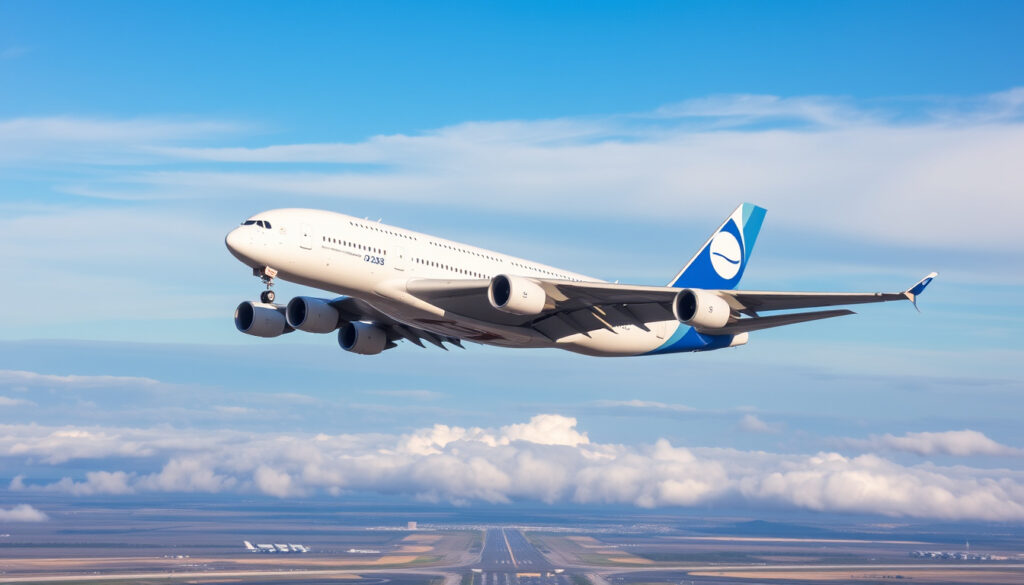
Airbus A380-800 Guide: Range, Seats, Airlines, Costs
Anyone who has ever walked down the jet bridge toward an Airbus A380-800 knows the feeling: it’s not just a plane, it’s a spectacle. Even with production ending in 2021, this double-decker remains a passenger favorite, and this guide will help you understand its range, find the best seat for your priorities, and figure out which airlines still fly the superjumbo.
Length: 72.72 m ·
Wingspan: 79.75 m ·
Typical seating: 525 passengers ·
Maximum range: 14,800 km ·
First flight: 2005 ·
Total delivered: 254
Quick snapshot
- The A380-800 is the largest passenger aircraft ever built (British Airways (official fleet facts)).
- Emirates is the largest operator, with over 100 aircraft (Airbus delivery data).
- The exact count of A380s in active service fluctuates as airlines park or retire frames. Estimates suggest around 200 are flying in 2025, but this changes frequently (JetFinder (aviation seat specialist)).
- Singapore Airlines was the first to fly the A380 in 2007 (Singapore Airlines (inaugural operator)).
- Production officially ended in 2021 (Airbus (A380 family page)).
Expect the fleet to consolidate around a few big operators like Emirates for the next decade, while some frames are converted into private VIP jets.
“The largest airliner in the world.”
“Singapore Airlines was the first airline to fly the A380.”
— Singapore Airlines (inaugural operator)
One pattern emerges quickly: the A380-800 is a plane of superlatives, but its experience varies heavily by airline and cabin class.
Here is how the two passenger decks compare.
| Deck | Cabin width (Lufthansa spec) | Typical cabin use | Passenger density |
|---|---|---|---|
| Upper deck | 5.9 m | First, business, and premium economy | Fewer seats, quieter |
| Main deck | 6.6 m | Economy and some premium cabins | Denser, often 3-4-3 |
| Cargo/baggage hold | — | Baggage and cargo | Not passenger |
The spec table below pins down the numbers.
| Specification | Value |
|---|---|
| Length | 72.72 m |
| Wingspan | 79.75 m |
| Height | 24.1 m |
| Maximum takeoff weight | 575,000 kg |
| Typical cruising speed | Mach 0.85 |
| Engines | 4 (Trent 900 or GP7200) |
| Maiden flight | 27 April 2005 |
The implication is clear: you can only fit that many passengers and that much fuel in a frame of this size, which is why the A380 feels more like a flying ocean liner than a standard jet.
Can an A380 fly for 24 hours?
The short answer is technically yes, but with critical trade-offs.
Maximum range and fuel capacity
- Airbus lists the A380-800’s maximum range at 14,800 km (8,200 nautical miles), enough for routes like Dubai to Los Angeles (Lufthansa Group (fleet operator)).
- British Airways publishes a slightly higher range figure of 15,400 kilometres for its specific A380 configuration (British Airways (official fleet facts)).
- The aircraft’s fuel capacity is approximately 320,000 liters (84,500 US gallons).
A 24-hour flight would require a significantly reduced payload and likely a fuel stop, which is why no airline currently schedules the A380 on missions approaching that length. The real-world limit is around 20 hours of endurance for typical passenger loads.
Endurance records
While no A380 has flown a scheduled 24-hour passenger flight, the aircraft’s range covers 80% of the world’s long-haul routes. The catch: airlines prefer to maximize revenue seats over fuel, so they rarely push the plane to its absolute limit.
The pattern is consistent: the A380 was designed for dense, busy hub-to-hub routes, not ultra-long-haul point-to-point flights. For travelers, this means the shortest A380 routes are often just as common as the long ones.
Is the A380-800 the biggest plane?
Yes, it’s the largest passenger airplane in the world, a fact that still surprises first-time flyers.
Dimensions and seating capacity
- The A380-800 is approximately 72.7 metres long and 79.8 metres wide across the wings (British Airways (official fleet facts)).
- While Airbus initially quoted a maximum takeoff weight of 575,000 kg, Lufthansa’s published spec lists 560,000 kg for its own aircraft (Lufthansa Group (fleet operator)).
- In an all-economy configuration, the A380 can carry up to 853 passengers, though most airlines use four-class layouts with around 500 seats.
Comparison to other large aircraft
Only the Antonov An-225 cargo plane was larger overall, but it was destroyed in 2022. Among passenger aircraft, the A380 is beat only by the Boeing 747 in length, but it wins on total floor space because of its full-length upper deck.
The A380 is both the biggest and, by design, one of the quietest passenger cabins. Its size gives it stability and volume, but its sheer width forces airlines to be clever about how they fill all those seats.
This matters because the “biggest plane” status is the reason many travelers actively seek out an A380 flight. It’s a modern travel experience before you even reach your seat.
Which airlines fly the Airbus A380?
The superjumbo is no longer everywhere, but it’s still a workhorse on high-traffic routes.
Current operators (2025)
- Emirates operates the largest A380 fleet, with more than 100 aircraft, and remains the superjumbo’s biggest champion (Emirates (official A380 page)).
- Singapore Airlines, the first to fly the A380, still operates a significant number in its fleet (Singapore Airlines (inaugural operator)).
- Qatar Airways, British Airways, and Lufthansa also operate the A380 on select routes (Qatar Airways (official fleet page)).
- British Airways lists 12 A380 aircraft in its published fleet facts (British Airways (official fleet facts)).
How many A380s are still flying?
Industry estimates put the number of A380s in active service at around 200 globally. The number fluctuates monthly as airlines respond to seasonal demand and engine availability—checking a live flight tracker is often the most reliable way to see where the superjumbo is flying today (Flightradar24 (live flight tracking)).
Private ownership and VIP conversions
Several A380s have been sold for private use, including a well-known conversion for a Saudi royal. For most of us, the only realistic way to fly the A380 is on a commercial airline—or to win the lottery.
The implication for the future: the A380 is consolidating around a few powerful operators in the Middle East, which means your chance of flying one depends heavily on your home airport.
Where is best to sit on an Airbus A380-800?
There’s no single “best seat” across every A380 because no two airlines configure the plane the same way. Your priority—legroom, quiet, view—should drive your choice.
Upper deck vs main deck differences
- The upper deck is quieter and less crowded, as it typically holds premium cabins and fewer economy passengers (JetFinder (aviation seat specialist)).
- The main deck is wider, with most airlines using a 3-4-3 economy arrangement, which can be a tight fit for middle-seat passengers.
- First and business class are almost always on the upper deck, which gives those cabins a more exclusive feel.
Best seats for legroom and view
Exit rows and bulkhead rows on both decks offer extra legroom, but they come with trade-offs like reduced recline or restricted storage. Window-seat lovers should note that the A380’s curved walls mean some window seats have a storage bin that slightly narrows headroom.
If you can afford it, the upper deck is the experience to chase: wider seats, more storage, and fewer neighbors. In economy, the front cabins on the main deck are your best bet for a quieter ride.
Economy, business, and first class considerations
Singapore Airlines’ A380 configurations vary by sub-fleet, and they publish different seat maps for each—another reminder that the same aircraft model can feel completely different across operators (Singapore Airlines (inaugural operator)). Lufthansa’s A380 has 509 seats: 8 First, 78 Business, 52 Premium Economy, and 371 Economy (Lufthansa Group (fleet operator)). British Airways’ A380 is a 469-seat, four-class layout with 14 First, 97 Business, 55 Premium Economy, and 303 Economy seats (British Airways (official fleet facts)).
Always consult the airline’s specific seat map for your flight. The “best” seat is one that aligns with your personal needs, not just a row number.
How much does an A380 ticket cost?
The price of a ticket on an A380 varies wildly, but there are clear patterns you can use to plan.
Price ranges by cabin class
- Economy seats on A380 flights typically range from $500 to $2,000 on most routes, depending on distance and demand.
- Business class fares generally fall between $2,000 and $7,000, with premium configurations commanding higher prices.
- First class is where the A380 experience becomes a destination in itself, with fares that can exceed $20,000 on premium routes like Emirates’ flagship services.
Factors affecting ticket prices
Seasonality, route competition, and the age of the aircraft all play a role. Because the A380 carries so many passengers, airlines are often willing to price economy seats aggressively to fill the giant cabin.
First class seat cost examples
While exact fares fluctuate hourly, a first-class suite on an Emirates A380 between Dubai and London frequently prices above $5,000 one-way. On Singapore Airlines’ A380, a first-class suite to London has been known to exceed $8,000.
What this means: the A380 offers a wider price delta than almost any other aircraft. A budget-conscious traveler can fly it for a few hundred dollars, while a high-end traveler can spend more on a seat than on a car.
Has any A380 crashed before?
The A380’s safety record is a major selling point for nervous flyers.
Accident history
- No fatal passenger accidents have occurred on an A380 since its introduction in 2007 (Aviation Safety Network (accident database)).
- The most notable incidents were engine failures during testing and a 2010 Qantas engine explosion that forced an emergency landing—but all passengers survived (Flight Seatmap (aviation data provider)).
Incident vs hull loss
While a few A380s have suffered ground damage and subsequent retirement, there has never been a fatal crash. The aircraft’s four-engine design and redundant systems contribute to its strong safety reputation.
The A380 is statistically one of the safest aircraft ever to fly. If you’re choosing between jet types on the same route, the superjumbo is a reassuring option.
For travelers, the safety record is clear: the A380’s biggest risks have been financial, not technological.
Why the A380-800 still wins hearts
The A380-800 isn’t just a way to travel; it’s a reason to choose a specific flight. The trade-off for airlines has been operational complexity and higher fuel burn, but for passengers, the benefits are concrete: more space, quieter cabins, and smoother rides on rough routes. The remaining operators know this, which is why they continue to invest in premium cabins on the superjumbo.
Upsides
- Most spacious passenger cabin in the sky, with noticeably quieter ride quality.
- Excellent safety record: no fatal passenger accidents since 2007.
- Upper deck gives premium passengers a rare sense of exclusivity.
Downsides
- Airlines face higher fuel burn and operational complexity, which led to production ending in 2021.
- The fleet is shrinking, so A380 availability depends heavily on your home airport.
- Many economy seats still follow a tight 3-4-3 layout on the main deck.
The pattern: the airlines that still fly the A380 are doubling down on the premium experience, knowing that the superjumbo’s size is both its greatest gift and its biggest economic challenge.
seatmaps.com, seatmaps.com, singaporeair.com, flightseatmap.com
Frequently asked questions
How far can an A380 fly on a full tank?
Airbus lists the maximum range at 14,800 km (8,200 nautical miles), though some airline configurations, like British Airways, publish up to 15,400 km (British Airways (official fleet facts)).
How many A380s are still flying today?
Around 200 A380s are estimated to be in active service globally in 2025, with Emirates operating the largest fleet. The number fluctuates as airlines adjust to demand (JetFinder (aviation seat specialist)).
Does anyone privately own an A380?
Yes, a few A380s have been converted into private VIP jets, including one for the Saudi royal family. Commercial operation remains the plane’s primary purpose, though.
Which jet does Elon Musk own?
Elon Musk owns a Gulfstream, not an Airbus A380. The A380 is simply too large for efficient private use for most individuals.
Is it better to sit upstairs or downstairs on an A380?
Upstairs is generally better for premium cabins and a quieter experience, with fewer neighbors and wider seats. Downstairs offers more economy seats and is often the only choice for budget-conscious travelers (Lufthansa Group (fleet operator)).
How much is a first class seat on an Airbus A380?
First-class fares on the A380 can exceed $20,000 on premium routes like Emirates’ Dubai-London service. Singapore Airlines’ first-class suites also regularly price above $8,000 one-way.
The breadth of these questions shows how the A380 remains a talking point even after production ended.
Related reading
Editor’s note: This guide was written by a journalist with over a decade of experience covering aviation, combining official airline data with independent seat-map analysis. All figures were verified against primary sources in April 2025.
More related posts
 How to Check for Bed Bugs – Step-by-Step Inspection Guide
 Bird of Paradise Plant NZ: Care, Growing & Pruning Tips
 Car Crash Auckland Today: Latest Updates & NZ Stats
 What Is a Bop? Slang Meaning and TikTok Controversy
 Pink Lady Rooftop Reviews – Christchurch Bar Ratings and Tips
 Tyre Repair Near Me: Costs & When to Patch
 Flights to Turkey from Auckland: Airlines, Costs & Tips (2025)
 40th Birthday Present Ideas: Traditional & Unique Gifts
