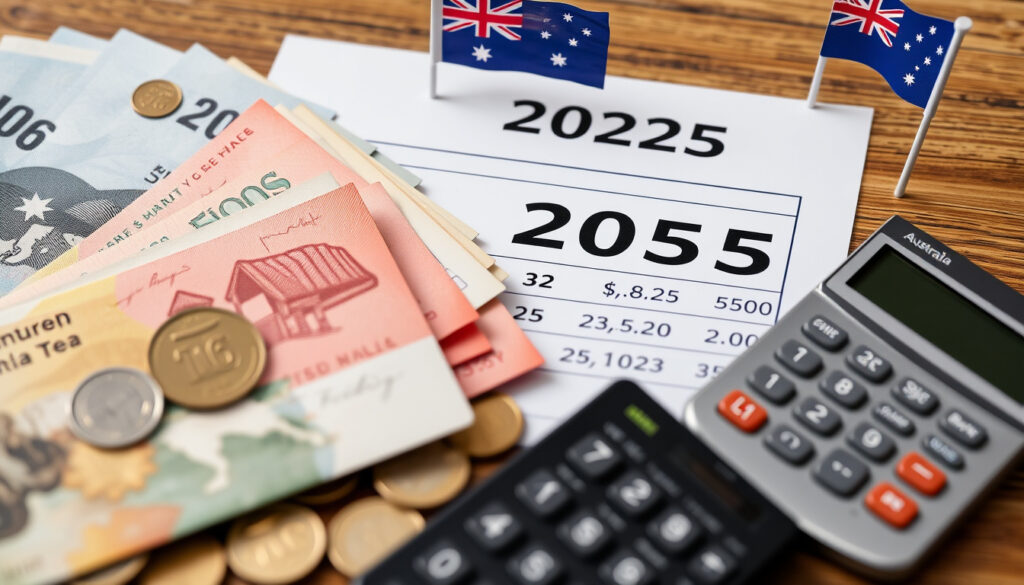
Minimum Wage in Australia 2025: Rates & Salary Guide
Australia’s national minimum wage is now $24.95 per hour as of July 2025, but that figure alone doesn’t tell you whether you’re earning enough to live comfortably. Here’s how this benchmark compares to common salary thresholds and what it means for your pay.
National minimum wage per hour (as of 1 July 2025): $24.95 ·
National minimum wage per week (38-hour week): $948 ·
Rate for casual employees (includes 25% loading): $31.19 per hour ·
Annual full-time minimum (approx.): $49,296 ·
Minimum wage for workers under 16: 36.8% of adult rate ($9.18/hour) ·
Effective date of current rate: 1 July 2025
Quick snapshot
- National minimum wage: $24.95/hour, $948/week (as of 1 July 2025) (Fair Work Commission)
- Casual loading of 25% brings the rate to $31.19/hour (Fair Work Commission)
- $50/hour equates to ~$98,800/year, well above average earnings (SEEK Salary Guide)
- International students are entitled to the same national minimum wage (Links International)
- No official “living wage” figure; estimates range from $25–$30/hour depending on location (Fair Work Commission)
- The “10 year rule” concept is often confused with tax or migration rules, not directly tied to minimum wage (Fair Work Commission)
- Future minimum wage increases beyond 2025 are not yet determined (Fair Work Commission)
- 1 July 2025: 3.5% increase to $24.95/hour (Fair Work Commission)
- 1 July 2024: previous rate $23.23/hour (QuickBooks Australia)
- Consistent annual increases since 2020 (average ~3% per year) (Fair Work Commission)
- Next review by Fair Work Commission expected mid-2026 (DLA Piper Knowledge)
- Superannuation guarantee rose to 12% on 1 July 2025 (DLA Piper Knowledge)
- High-income threshold for award coverage increased to $183,100 (Fair Work Commission)
Six key numbers define the current minimum wage landscape in Australia — one pattern: the gap between the legal floor and what most people actually earn has been widening.
| Key facts | Value |
|---|---|
| National minimum wage (hourly) | $24.95 AUD (≈ $16.70 USD) |
| National minimum wage (weekly) | $948 AUD |
| Casual minimum wage (hourly) | $31.19 AUD |
| Effective from | 1 July 2025 |
| Average full-time salary (2025) | ~$92,000 AUD per year |
| Median full-time salary | ~$72,000 AUD per year |
What is the minimum wage in Australia per hour?
National minimum wage rate (2025)
The Fair Work Commission announced a 3.5% increase on 3 June 2025, effective from the first full pay period starting on or after 1 July 2025. The new national minimum wage is $24.95 per hour, translating to $948 per week for a 38-hour week (Fair Work Commission, Australia’s national workplace relations tribunal). This increase affects approximately 2.7 million workers (Employment Compass, employment advisory firm).
Minimum wage for casual employees
Casual workers receive a 25% loading on top of the minimum rate, bringing their hourly wage to $31.19. This compensates for lack of paid leave entitlements.
Minimum wage for workers under 21 and apprentices
Workers under 16 receive just 36.8% of the adult rate — that’s $9.18 per hour. Rates for 16-to-20-year-olds scale up gradually, and apprentices have their own award-specific percentages (Australian Unions, worker advocacy organisation).
How does award coverage affect minimum pay?
Many industries are covered by “modern awards” that set minimum rates higher than the national minimum. For example, hospitality and retail awards typically pay a few dollars more per hour. If an award applies, the employer must pay at least the award rate.
The implication: the gap between the minimum and actual earnings can be significant, especially for those in award-covered roles.
Is $50 per hour a good wage in Australia?
What salary does $50/hour translate to annually?
At $50 per hour for a standard 38-hour week, the annual pre-tax salary is approximately $98,800 (SEEK Salary Guide). That is more than double the national minimum wage of $49,296 and well above the average full-time salary of $92,000.
How does $50/hour compare to the national median wage?
The median full-time salary in Australia is around $72,000. At $98,800, a $50/hour earner sits in the upper third of the income distribution — comfortably above the midpoint.
What jobs pay $50 an hour in Australia?
Registered nurses, electricians, and mid-level IT professionals commonly earn around this rate. For example, an electrician with 5 years of experience averages $50–$55 per hour (Indeed Career Guide). However, location matters: in Sydney, the same role may pay less relative to living costs than in Perth.
A $50/hour wage sounds great on paper, but in high-rent suburbs of Sydney or Melbourne, after tax and rent, it may leave only $1,500–$2,000 per month for other expenses. The catch: purchasing power varies dramatically by city.
The pattern: headline numbers often overstate real purchasing power when rent is factored in.
Is $75,000 a good salary in Australia?
How does $75,000 compare to average earnings?
$75,000 is slightly above the median full-time salary (~$72,000) but below the average ($92,000). It places a worker in the middle of the income distribution.
What is the take-home pay from $75,000?
After income tax (2025–26 rates), a $75,000 salary yields roughly $5,300 per month (excluding Medicare levy and deductions) (Australian Tax Office calculator).
What lifestyle can you afford on $75,000?
In Adelaide or Perth, $75,000 supports a moderate lifestyle with some savings. In Sydney or Melbourne, it may be tight: median rent for a one-bedroom apartment in Sydney is around $600/week, consuming about half the take-home pay (Domain Rental Report).
What looks like a decent salary on paper can feel like a squeeze in high-rent suburbs. The gap between minimum wage and $75,000 is about $25,000 per year — yet after tax and housing, the difference in disposable income may be only a few hundred dollars a week.
What this means: location is the decisive factor in whether this salary feels comfortable.
What is the minimum wage in Australia for international students?
Do international students receive the national minimum wage?
Yes. International students with work rights are entitled to the same national minimum wage of $24.95/hour (or the relevant award rate) (Links International, migration and education agency).
Work hour limits for international students
During study terms, international students can work up to 48 hours per fortnight. During scheduled breaks, unlimited hours are permitted (Department of Home Affairs).
Award rates for hospitality and retail jobs common among students
Many students work in hospitality or retail, where award rates are slightly above the national minimum. For example, a Level 1 hospitality employee (casual) earns about $30–$32 per hour depending on shift time.
The 48-hour fortnight limit can be a trap: students who exceed it risk visa cancellation, yet many employers — especially in hospitality — pressure staff to go over. Knowing your rights is critical.
What is a living wage in Australia vs the minimum wage?
How much do you need to live comfortably in Australia?
Living wage estimates vary widely. The Australian Council of Social Service (ACOSS) suggests a single adult in Sydney needs around $28–$30 per hour for a basic but adequate standard of living, factoring in rent, utilities, food, and transport (ACOSS, national peak body for poverty).
Living wage estimates by city
- Sydney: $28–$32/hour for a single adult
- Melbourne: $26–$29/hour
- Brisbane: $24–$27/hour
- Perth: $23–$26/hour
These figures are based on cost-of-living data from Numbeo, crowd-sourced cost database.
The gap between minimum wage and living wage
With the national minimum at $24.95, a worker in Sydney earning minimum wage falls short of the living wage by $3–$7 per hour. That’s a shortfall of $120–$280 per week on a 40-hour week — a stark difference in disposable income (Employment Compass).
Australia’s minimum wage is among the highest in the world, yet in the most expensive cities it still doesn’t cover a modest lifestyle. The rule of thumb: if you earn minimum wage, avoid living in Sydney unless you’re sharing a house with at least two others.
The implication: the one-size-fits-all minimum creates winners and losers depending on where you live.
What is the average salary and how does it compare to minimum wage?
Average full-time salary in Australia (2025)
The average full-time salary is approximately $92,000 per year – nearly double the minimum wage annual equivalent (SEEK Salary Guide).
Average salary by industry
- Mining: $140,000+
- Information technology: $110,000
- Finance: $100,000
- Retail: $62,000
- Hospitality: $58,000
Data from SEEK Salary Guide.
Average salary by state and territory
- ACT: $105,000
- Western Australia: $98,000
- New South Wales: $92,000
- Victoria: $89,000
- Tasmania: $76,000
Based on Australian Bureau of Statistics.
If you’re considering buying a home, check our guide on the First Home Buyers Grant and see how interest rate changes by banks affect mortgages in our analysis of Interest Rate Cuts Banks.
Comparison: $50/hr, $75k/yr, $7k/month – what’s the real difference?
Three common thresholds, one key pattern: after tax and rent, the gap between $50/hr and $75k/yr is smaller than the headline numbers suggest.
| Salary threshold | Annual pre-tax | Monthly take-home (approx.) | After rent in Sydney (single) | Lifestyle rating |
|---|---|---|---|---|
| $50/hour | $98,800 | $5,900 | $2,500 | Comfortable in most cities, tight in Sydney |
| $75,000/year | $75,000 | $5,300 | $1,900 | Moderate, squeeze in Sydney/Melbourne |
| $7,000/month | $84,000 | $7,000 | $3,600 | Good, allows savings outside Sydney |
The implication: $50/hour (≈$98k/year) gives you about $1,200 more per month after rent than $75k/year – not a life-changing difference, but enough to avoid financial stress.
Upsides and downsides of different salary levels
Upsides
- Minimum wage earners benefit from regular legislated increases (e.g., 3.5% in 2025)
- Casual loading (25%) provides meaningful boost for flexible workers
- Earning $50/hour puts you in the top 30% of full-time earners
- International students have same legal protections as domestic workers
Downsides
- Minimum wage still falls short of living wage in Sydney/Melbourne
- Young workers (under 16) earn only $9.18/hour – far below any living standard
- High rent in capital cities consumes 40–50% of take-home pay even on $75k
- International students face 48-hour fortnight cap and visa risks
Timeline of recent minimum wage changes in Australia
- 1 July 2025: $24.95/hour ($948/week) – 3.5% increase
- 1 July 2024: $23.23/hour ($882.80/week) – increase
- 1 July 2023: $21.38/hour ($812.60/week) – increase
- 1 July 2022: $20.33/hour ($772.60/week) – increase
- 1 July 2021: $19.84/hour ($753.80/week) – increase
- 1 July 2020: $19.49/hour ($740.80/week) – increase
Data from Fair Work Commission and QuickBooks Australia (payroll and accounting platform).
What is confirmed and what is still unclear
Confirmed
- National minimum wage is $24.95/hour as of 1 July 2025 (Fair Work Ombudsman).
- $50/hour is well above the national minimum wage and median earnings.
- $75,000/year is slightly above the median full-time salary.
- International students are entitled to the national minimum wage.
- Jobs paying $300,000/year are mostly in medical specialisations.
Unclear
- Exact living wage varies by city; no official government living wage figure exists.
- The “10 year rule” as a wage concept is not directly tied to minimum wage – likely refers to tax or migration rules.
- Future minimum wage increases beyond 2025 are not yet known.
Expert perspectives on minimum wage in Australia
“Australia’s national minimum wage is $24.95 per hour as of 1 July 2025. Workers covered by an award may get a higher rate, but no one can be paid less than this minimum.”
“The minimum wage increase of 3.5% means an extra $32.30 per week for a full-time worker on the national minimum. But many workers earn under awards which already set higher rates.”
“When you earn minimum wage, every dollar counts. Knowing whether you’re casual or permanent, under an award or not, changes what you’re owed.”
“The average full-time salary in Australia is around $92,000 – that’s nearly double the minimum annual wage of $49,296. But averages hide big differences across industries and locations.”
bookkeepingdepartment.com.au, squareup.com, studyaustralia.gov.au, linksinternational.com
For a detailed breakdown of how the $24.95 per hour rate applies across different award categories, see Australias 2025 minimum wage rates.
Frequently asked questions about minimum wage in Australia
What is the minimum wage in Australia for a 20-year-old?
For a 20-year-old not covered by an award, the minimum wage is a percentage of the adult rate: 85% of $24.95 = approximately $21.21 per hour (Fair Work Commission).
Is the minimum wage in Australia enough to live on?
It depends on location. In Sydney or Melbourne, minimum wage alone is not enough for a single person to live comfortably without sharing housing. In cheaper cities like Adelaide or Perth, it can cover basics but leaves little for savings (ACOSS).
What is the minimum wage in Australia in USD?
As of July 2025, with AUD/USD around 0.67, $24.95 AUD ≈ $16.70 USD per hour. This is still one of the highest minimum wages in the world (XE Currency Converter).
Do all workers in Australia receive the minimum wage?
Most employees covered by the national system are entitled to at least the minimum wage. However, award-covered workers may receive higher rates, and some categories (e.g., apprentices, trainees) have different minima (Fair Work Commission).
How often does the minimum wage change in Australia?
Once per year, effective 1 July. The Fair Work Commission conducts an Annual Wage Review and announces the decision in early June (Fair Work Commission).
What is the penalty rate for weekend work?
Penalty rates depend on the award. For example, in hospitality, Saturday rates are 125% of the base rate, Sunday 175%, and public holidays 250% (Fair Work Commission).
Can an employer pay less than the minimum wage?
No. It is illegal to pay below the national minimum wage or the applicable award rate. Employers who do so face fines and back-pay orders. If you suspect underpayment, contact the Fair Work Ombudsman (Fair Work Ombudsman).
What jobs pay $300,000 in Australia?
High-paying professions: surgeons, anaesthetists, CEOs
Medical specialists are the most common $300k+ earners. According to the SEEK Salary Guide, surgeons earn around $300k–$450k, anaesthetists $300k–$400k. CEOs of large companies can also exceed $300k.
How many jobs actually pay $300k?
These roles represent less than 1% of the Australian workforce. Most are in medicine, senior executive roles, or specialised IT architecture (ABS Labour statistics).
Alternative high-income careers without a medical degree
IT enterprise architects, mining engineers, and senior petroleum engineers can reach $250k–$300k. However, these paths require advanced qualifications and years of experience.
For the average Australian worker, the gap between minimum wage ($49k/year) and a comfortable salary ($75k–$100k) is real but not insurmountable — if you live in a city where rent doesn’t consume half your income. For international students, the minimum wage provides a decent base, but the 48-hour fortnight cap makes it tough to cover full living costs. The implication is clear: research your city’s rental market before you accept that job offer, or consider relocating to a more affordable state.
More related posts
 John-Paul Foliaki: Actor, Age, Movies, Height & Instagram
 Palmerston North Things to Do – Top Attractions and Free Activities
 Things to Do in Nadi, Fiji: Top Attractions & Travel Guide
 Cast of Madagascar 2005: Full Voice Actors and Characters
 Best Plant Protein Powder NZ: Top Brands Compared (2025)
 South Island heavy rain snow: live warnings and forecast
 ChatGPT – Features, Pricing and Models Guide
 All Blacks vs France Live Score & Nations Championship Updates
