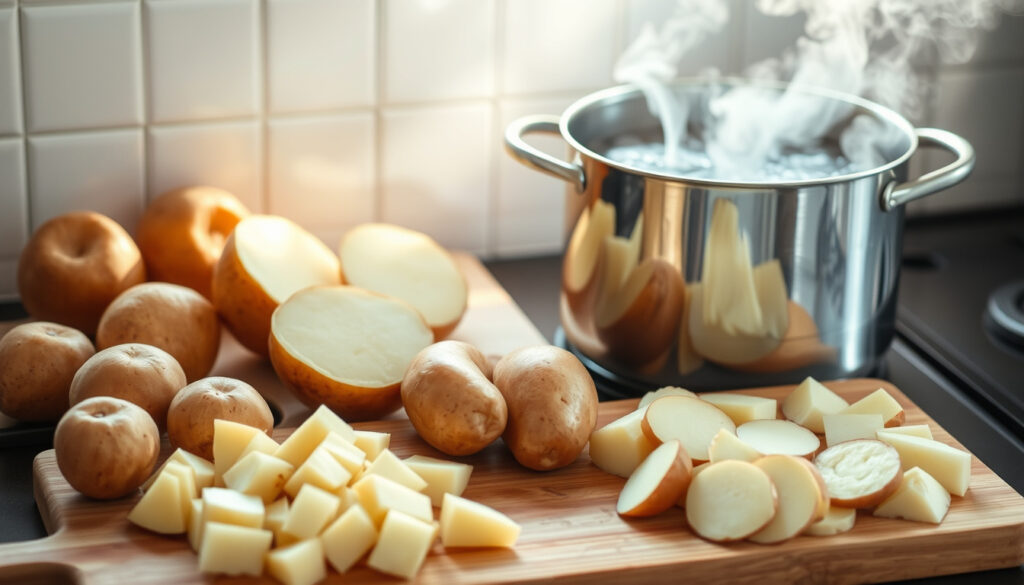
How Long to Boil Potatoes: Times for Every Cut
There’s something comforting about a pot of potatoes bubbling on the stove — but getting them just right can be surprisingly tricky. Whether you’re aiming for fluffy mashed potatoes or firm cubes for a salad, the cooking time depends on size, cut, and even whether you keep the lid on.
Small potatoes (1-2 inch): 12–15 minutes ·
Medium potatoes (2-3 inch): 20–25 minutes ·
Large whole potatoes (3+ inch): 30–40 minutes ·
Diced potatoes (½–1 inch): 10–15 minutes ·
Test for doneness: Fork-tender
Quick snapshot
- Small potatoes cook faster than large ones (The Cookful)
- Boiling with lid on reduces cooking time (Suzie the Foodie)
- Starting in cold water results in more even cooking (Tasting Table)
- Whether lid-on or lid-off yields better texture depends on preference (Eat With Us)
- Optimal starting water temperature (cold vs boiling) varies by recipe tradition (Tasting Table)
- Diced: 10–15 min (Eat With Us)
- Small whole: 12–15 min (The Cookful)
- Medium whole: 20–25 min (Eat With Us)
- Large whole: 30–40 min (The Cookful)
- Try cold-water start vs boiling-water start
- Experiment with lid on vs off
- Test doneness with a fork after minimum time
Four key facts, one pattern: the size of the potato determines the window, but the method (lid, water start) shifts the outcome.
| Factor | Detail |
|---|---|
| Minimum boil time (baby potatoes) | 12 minutes |
| Maximum time for large whole | 40 minutes |
| Water level | 1 inch above potatoes |
| Salt concentration | 1 tbsp per 4 cups water |
The catch: these times assume a gentle simmer, not a rolling boil — a rolling boil can break the potatoes apart before the center is tender (Alibaba Spice Basics).
How long should you boil potatoes?
Boiling times for whole potatoes
- Small (1–2 inch diameter): 12–15 minutes (The Cookful)
- Medium (2–3 inch): 20–25 minutes (Eat With Us)
- Large (3+ inch): 30–40 minutes (The Cookful)
One home cook’s test found whole potatoes were fork-tender in about 11 minutes from a cold start, but that’s unusually fast — most guides recommend checking after 10 minutes and adding time if needed (Sutton Elms).
Boiling times for diced potatoes
- ½–1 inch cubes: 10–15 minutes (Eat With Us)
Diced potatoes cook faster because more surface area is exposed to the water. The trade-off: they can turn mushy if you leave them even a minute past done.
Testing for doneness
The most reliable test: a knife, fork, or skewer should slide into the thickest part of the potato with no resistance (The Cookful). Don’t rely on the clock alone — start testing at the lower end of the range.
Home cooks who test early avoid the two biggest texture failures: a crunchy center or a waterlogged shell. The difference between “done” and “overdone” is often less than 2 minutes.
The pattern: size is the primary variable, but cut (whole vs diced) can halve the time. For mashed potatoes, overcooking by even 3 minutes can make them gluey — so test early and often.
Is 10 minutes enough to boil potatoes?
When 10 minutes works
- Small diced potatoes (½ inch cubes) can be tender in 10 minutes (Eat With Us)
- Baby potatoes cut in half may also be ready at 10–12 minutes
When 10 minutes is not enough
- Medium whole potatoes need at least 20 minutes
- Large whole potatoes need 30+ minutes
One guide notes that most potatoes take between 10 and 20 minutes, but that’s only for smaller or cut pieces (The Cookful).
If you’re boiling whole medium potatoes and pull them after 10 minutes, you’ll get hard cores — a common mistake that ruins the texture for potato salad or mash.
Why this matters: the 10-minute mark is a useful checkpoint, but only for small cut pieces. For anything else, it’s a false promise.
Is it better to boil potatoes with the lid on or off?
Benefits of boiling with lid on
- Brings water to a boil faster — saves energy and time (Suzie the Foodie)
- Traps heat, speeding up the cooking process
Benefits of boiling with lid off
- Prevents water from boiling over onto the stovetop
- Allows steam to escape, which can reduce the starchy foam that makes water cloudy (Alibaba LifeTips)
- Some argue that condensation dripping from the lid can make potatoes soggy if left on the whole time
Two approaches, one trade-off: lid on saves time; lid off gives better texture control.
| Factor | Lid on | Lid off |
|---|---|---|
| Time to boil | Faster | Slower |
| Risk of boil-over | Higher | Lower |
| Starch release | More, water gets cloudy | Less, clearer water |
| Texture outcome | Softer, possibly waterlogged | Firmer, less water absorption |
The compromise: many experts recommend using the lid only to bring the water to a boil, then removing it for the simmer phase (Suzie the Foodie).
If you keep the lid on during the entire simmer, the steam can cause the potatoes to absorb more water, making them waterlogged — especially a problem for mashed potatoes that you want fluffy, not dense.
The trade-off: lid-on speeds up the cook but risks texture; lid-off takes longer but gives you more control. For most home cooks, the hybrid approach is the safest bet.
Do you start boiling potatoes in cold or boiling water?
Arguments for starting in cold water
- Ensures even cooking from the inside out — the potato heats up gradually, so the center cooks at the same rate as the exterior (Tasting Table)
- Recommended by multiple cooking guides as the standard method (Tasting Table)
- One guide says to start in cold water, bring to a boil with the lid on, then simmer with lid off (The Cookful)
Arguments for starting in boiling water
- Reduces overall cooking time because the water is already hot
- Can work well for small cut potatoes that cook quickly anyway
- Some recipes (especially for potato salad) call for dropping into boiling water to keep the shape
One reported downside of cold-water start: the potatoes can become waterlogged if left in the water too long before reaching a boil (Alibaba LifeTips).
For uniform tenderness — especially when boiling whole potatoes — the cold-water start is the method trusted by most professional kitchens. The boiling-water start is a shortcut that works best for small, uniform pieces.
The pattern: the cold-start method reduces the risk of a raw center, but requires a bit more patience. For diced potatoes that take only 10 minutes, the difference is negligible.
What are common mistakes when boiling potatoes?
Overcooking
- Leads to mushy, waterlogged potatoes that fall apart
- Especially problematic for mashed potatoes, which become gluey when overworked with waterlogged starch
Undercooking
- Results in hard, crunchy centers — a common failure when boiling large whole potatoes without testing
Not salting the water
- Salt enhances the potato’s natural flavor; without it, the potatoes taste bland (Culinary Hill)
- Recommended: 1 to 2 teaspoons of salt per quart of water (Alibaba Spice Basics)
Using too little water
- Potatoes should be covered by about 1 inch of water (Suzie the Foodie)
- Too little water leads to uneven cooking and can cause the pot to boil dry
Crowding the pot
- Overcrowding causes uneven cooking because the potatoes don’t have enough water circulation (Alibaba Spice Basics)
- Use a pot large enough so the potatoes are in a single layer
Crowding the pot is the most common source of uneven doneness — the outer potatoes cook faster than the ones in the center. A bigger pot costs nothing but fixes the problem.
The implication: most potato-boiling failures aren’t about time — they’re about method. Fix the water level, salt, and pot size, and the timing becomes almost automatic.
Step-by-step: How to boil potatoes perfectly
- Prep the potatoes: Wash and scrub; peel only if desired. Cut into uniform sizes (whole, halved, or diced).
- Choose your pot: Use a pot large enough so potatoes fit in a single layer. Add enough cold water to cover by 1 inch (Culinary Hill).
- Salt the water: Add 1 tbsp salt per 4 cups water (or 1–2 tsp per quart).
- Start cold: Place potatoes in cold water, bring to a boil with the lid on.
- Simmer uncovered: Once boiling, remove the lid and reduce heat to a gentle simmer. Do not stir (The Cookful).
- Test for doneness: After the minimum time, pierce a potato with a fork. It should slide in easily.
- Drain and serve: Drain immediately to stop cooking. For mashed potatoes, return to the hot pot briefly to steam off excess moisture.
The catch: skipping the cold-water start or leaving the lid on during the whole simmer are the two most common deviations from this method — and they’re the ones most likely to cause uneven texture.
Clarity: What we know and what we don’t
Confirmed facts
- Small potatoes cook faster than large ones (The Cookful)
- Boiling with lid on reduces cooking time (Suzie the Foodie)
- Starting in cold water results in more even cooking (Tasting Table)
- Test doneness with a fork or knife (The Cookful)
- Salt the water for better flavor (Culinary Hill)
What’s unclear
- Whether lid-on or lid-off yields better texture — depends on preference (Eat With Us)
- Optimal starting water temperature (cold vs boiling) varies by recipe tradition (Tasting Table)
- Exact timing for very large potatoes can vary by variety and freshness (Sutton Elms)
The pattern: the fundamentals are settled — size, salt, and cold start are backed by multiple sources. The finer points (lid policy, exact water temperature) remain open to experimentation.
Quotes from the experts
“Start potatoes in cold water for even cooking. Dropping them into boiling water can cook the outside too fast, leaving the center raw.”
— Tasting Table (cooking tips)
“There is no need to stir potatoes while they boil. Just let them simmer gently.”
— The Cookful (kitchen guide)
The pattern: both experts agree that gentle cooking and testing are key to avoiding texture failures.
Summary
For the home cook, the key to perfectly boiled potatoes is not a single magic number — it’s the combination of size awareness, cold-water start, and a thoughtful lid strategy. The difference between a fluffy potato and a waterlogged one comes down to a few small decisions: start cold, salt generously, test early, and don’t let the lid trap steam during the simmer. For anyone who cooks potatoes regularly, the choice is clear: master the method, and the timing takes care of itself.
For more cooking guides, check out our article on Slow Cooked Beef Brisket: Best Method, Temperature & Mistakes and How Long to Cook Chicken Nibbles in Air Fryer | Time & Temp Guide.
howlongtoboilpotatoes.org, mailer.chf.org.au, ourgabledhome.com
For a comprehensive breakdown of boiling times for every potato cut, this guide covers whole, diced, and mashed potatoes with precise timings.
Frequently asked questions
Should you peel potatoes before boiling?
Peeling is optional. For mashed potatoes, peeling leads to a smoother texture; for potato salad, skin-on adds structure. Small potatoes can be boiled with skins on and eaten whole.
How do you know when potatoes are done?
Pierce the thickest part with a fork or knife. It should slide in with no resistance — that’s the standard test (The Cookful).
Do you need to salt the water when boiling potatoes?
Yes. Salt seasons the potatoes from the inside. Use 1 to 2 teaspoons per quart of water (Culinary Hill).
Can you boil potatoes in a steam basket?
Yes, but the timing is similar — steam takes about the same time as a simmer. The advantage is that the potatoes are less likely to become waterlogged.
How long to boil potatoes for potato salad?
For potato salad, you want firm but tender potatoes. Boil diced or medium whole potatoes until just fork-tender — about 15–20 minutes for medium whole, 10–12 minutes for diced.
What is the best variety of potato for boiling?
Waxy varieties like Yukon Gold, red potatoes, or new potatoes hold their shape well. Russets are starchy and better for mashing.
More related posts
 Japanese Food Near Me: Best Spots & Etiquette
 Liverpool F.C. vs Atlético Madrid Stats: H2H, Results & Records
 What to Do in Invercargill: Attractions & Rolling Stones History
 Best Shares Buy Now: Top Stocks & Trending Picks
 Bird of Paradise Plant NZ: Care, Growing & Pruning Tips
 Peel Off Lip Stain: Does It Work? Facts & Top Picks
 Kiri Te Kanawa Theatre Guide: Seating, Capacity, Parking & Events
 Australia New Zealand Visa Changes – What Kiwis Need To Know
