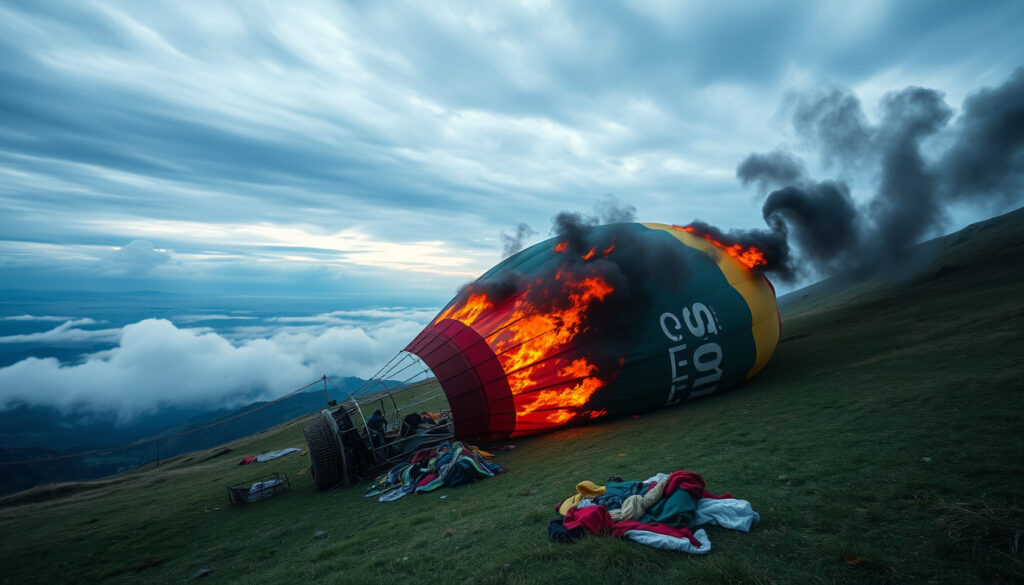
Hot Air Balloon Crash Brazil: 8 Dead in 2025 Santa Catarina Fire
On the morning of June 21, 2025, a hot air balloon lifted off from Praia Grande, Santa Catarina, carrying 21 passengers who had paid 550 reais each for a holiday flight over southern Brazil. Thirteen people would walk away. Eight would not. The tragedy, which investigators believe started with the balloon’s burner system, became the deadliest aviation accident in Brazil’s history and the most lethal hot air balloon crash anywhere in the world since 2016.
Date: June 21, 2025 · Location: Praia Grande, Santa Catarina, Brazil · Fatalities: 8 · Total on board: 21 · Survivors/Injured: 13
Quick snapshot
- Exact ignition source remains under investigation
- Whether pilot took immediate action or delayed evacuation order
- Whether any regulatory violations occurred in pre-flight checks
- Crash occurred just six days after another fatal Brazil balloon incident
- Investigators have 30 days to deliver preliminary findings
- CENIPA, Fire Department, and Scientific Police continue joint investigation
- ANAC examining operator credentials and crew certification
- Federal government placed at victims’ families’ disposal
The table below consolidates the core details verified across multiple sources.
| Field | Detail |
|---|---|
| Date | June 21, 2025 |
| Location | Praia Grande, Santa Catarina |
| Operator | Sobrevoar Serviços Turísticos |
| Fatalities | 8 |
| Injured | 13 (including 2 with second-degree burns) |
| Fire start time | 9:30 a.m. BRT |
| Time into flight | 2 minutes |
| Cost per passenger | 550 reais (~$100) |
Why did the hot air balloon crash in Brazil?
The balloon, operated by Sobrevoar Serviços Turísticos, lifted off from Praia Grande around 9:30 a.m. local time on June 21, 2025. According to investigators, the craft was equipped with a flame-retardant envelope — yet an intense fire ignited within two minutes of takeoff, roughly 1,000 meters above ground (Vatican News). The planned route was meant to last 45 minutes.
Preliminary findings indicated the blaze may have started with the burner system’s blowtorch, which operators use to heat air and maintain lift. Lt. Col. Zevir Cipriano Jr., a military firefighter, placed the accident time around 8 a.m. local time, noting that people had to physically hold the balloon down during launch because it was unstable (Hindustan Times). Witnesses reported the balloon swaying violently as winds picked up, with instability possibly linked to a weather conditions change or a gas leak.
Reported cause of the fire
Santa Catarina police chief Ulisses Gabriel stated that several people had to brace the basket during takeoff due to unusual movement. Investigators reportedly believe the burner mechanism — the device that heats air inside the envelope — may have been the ignition point. Authorities also examined whether adverse weather conditions or human error contributed to the failure.
Sequence of events
Praia Grande police chief Tiago Luiz Lemos reported that once the fire broke out, the pilot brought the balloon low enough to order passengers to jump. Those who leapt quickly are believed to have been the ones who survived. However, several occupants failed to exit in time. Once their weight was removed from the basket, the balloon shot upward without them — trapping eight people inside as the craft drifted and ultimately crashed near a healthcare center in a wooded area two kilometers from the takeoff site.
How many people survived the hot air balloon accident in Brazil?
Of the 21 people on board, 13 survived. Four passengers burned to death inside the basket. Another four died after falling from the basket as it rose or during the crash. Five survivors, including two with second-degree burns, received treatment at Nossa Senhora de Fátima municipal hospital (Wikipedia).
Casualty breakdown
The death toll of eight makes this the deadliest hot air balloon accident in Brazil’s history. Globally, it ranks as the most lethal since 2016, when a collision with power lines near Lockhart, Texas, killed 16 people.
Injury details
Survivors who jumped from the basket suffered injuries consistent with falls from height. Hospital records indicate at least two survivors required treatment for second-degree burns. All 13 survivors were transported to local medical facilities following the crash. Common injury symptoms after such falls include fractures, soft tissue trauma, and burns.
How did anyone survive the Brazil hot air balloon?
The survivors lived because the pilot acted quickly. Once the fire ignited, the pilot reduced the balloon’s elevation, bringing it close enough to the ground for passengers to leap. Praia Grande police chief Tiago Luiz Lemos confirmed that the pilot ordered people to jump when the basket was very low. Those who moved immediately escaped; those who hesitated did not.
Escape methods
Eyewitness accounts and official statements suggest survivors jumped from the basket while it was still low enough above ground to allow relatively safe landings. The rapid descent ordered by the pilot gave a critical window — however brief — for evacuation.
Survivor accounts
Reports indicate that survivors jumped before video footage of the incident began circulating on social media, meaning the earliest escape attempts predated any publicly available documentation. The survivors who made it to the ground were then rushed to hospitals in the area.
The pilot’s decision to bring the balloon low enough to jump likely saved 13 lives. Without that maneuver, the death toll would almost certainly have been higher — and this crash would have rivaled the 16-fatality 2016 Lockhart, Texas incident.
What was the most fatal hot air balloon accident?
The June 21 crash in Praia Grande is now the deadliest hot air balloon accident in Brazilian history. Globally, it surpasses every hot air balloon crash since 2016, when 16 people were killed near Lockhart, Texas, after their balloon collided with power lines (Wikipedia).
Brazil crash context
The Praia Grande incident occurred just six days after another fatal hot air balloon crash in Capela do Alto, São Paulo state, which killed a 27-year-old woman and injured 11 others on June 15, 2025. That balloon was unlicensed and carried 35 people. A third incident — a balloon falling on the coast of São Paulo — occurred later in the week with no serious damage reported (ABC30).
Historical comparisons
The last comparable global event was the 2016 Lockhart crash in Texas, which involved a collision with electrical infrastructure rather than an in-flight fire. The Brazil incident, involving a fire that spread through a supposedly flame-retardant envelope, represents a distinct failure mode — one that regulatory and industry authorities are now examining closely.
Hot air balloons have no engine or control surfaces to fail, which makes the Brazil crash especially troubling for regulators who believed that lack of mechanical complexity translated to inherent safety.
Who were the victims and survivors of the Brazil hot air balloon crash?
The eight people who died represented a cross-section of families and professionals from southern Brazil. They included two couples, a mother and her daughter, an ophthalmologist, and a figure skater from Santa Catarina and Rio Grande do Sul states. Most were in Praia Grande enjoying the Feast of Corpus Christi holiday weekend.
Identified victims
Among the deceased were individuals described as prominent in their communities. The presence of multiple couples and a mother-daughter pair indicates the crash struck family groups. The inclusion of an ophthalmologist and a figure skater suggests diverse backgrounds among the passengers.
Survivor conditions
The 13 survivors were taken to Nossa Senhora de Fátima municipal hospital. Five required medical attention, with two treated specifically for second-degree burns. Their conditions varied from minor injuries to more serious trauma consistent with the falls from height during evacuation.
The victims’ profiles illustrate how broadly this tragedy touched southern Brazil’s communities.
Timeline
The key events unfolded in a matter of minutes on June 21, 2025.
| Time / Period | Event |
|---|---|
| June 21, 2025, ~9:30 a.m. BRT | Hot air balloon catches fire two minutes into flight over Praia Grande |
| Immediate | Pilot reduces elevation, orders passengers to jump; 13 people leap from basket |
| After weight loss | Balloon rises sharply with eight people still inside, trapping victims |
| Crash moment | Balloon crashes near healthcare center, two kilometers from takeoff site |
| Post-crash | Survivors rushed to Nossa Senhora de Fátima municipal hospital |
What we know, what we don’t
Three agencies — the Aeronautical Accidents Investigation and Prevention Center (CENIPA), Santa Catarina’s Fire Department, and the Scientific Police — are jointly examining the crash. ANAC, Brazil’s civil aviation authority, is separately reviewing the operator’s credentials. The investigation has 30 days to produce preliminary findings, according to public safety secretary Flavio Graff.
Confirmed
- Fire started two minutes into flight
- 21 people on board, 8 killed, 13 survived
- Balloon operated by Sobrevoar Serviços Turísticos
- Location: Praia Grande, Santa Catarina
- Survivors jumped on pilot’s order while balloon was low
- 4 burned to death, 4 died after falling
- Six days earlier, another fatal crash occurred in São Paulo state
Unclear
- Exact ignition source
- Whether pilot’s actions were timely or delayed
- If pre-flight checks were properly conducted
- Whether any regulatory violations occurred
- Whether Sobrevoar’s claimed safety compliance is accurate
The confirmed facts anchor the investigation, but the unresolved questions about regulatory oversight will determine how Brazilian authorities respond.
Official response and investigation
President Luiz Inácio Lula da Silva expressed solidarity with victims’ families on social media and placed the federal government at their disposal. The operator, Sobrevoar, stated it had complied with all safety regulations and maintained a clean accident record prior to the incident. ANAC confirmed it is examining the aircraft and crew situation.
Authorities opened an investigation with results to be made public within 30 days.
— Flavio Graff, Santa Catarina public safety secretary (Wikipedia)
Several people had to hold the balloon down during launch due to instability.
— Ulisses Gabriel, chief of police, Santa Catarina (Hindustan Times)
The investigation will determine whether the burner system, operator maintenance, or pilot decisions were the primary failure point. If the open flame is confirmed as the ignition source, it raises questions about why a supposedly flame-retardant envelope failed — and whether existing safety standards are adequate for the equipment being flown.
The discrepancy between Ulisses Gabriel’s account of people holding the balloon down at launch and the official timeline underscores how witness recollection can diverge from the documented sequence.
This Santa Catarina tragedy underscores risks in Brazil hot air balloon incidents, despite ballooning’s strong global safety record amid occasional hard landings.
Frequently asked questions
What happened during the 2025 Santa Catarina hot air balloon crash?
A hot air balloon operated by Sobrevoar Serviços Turísticos caught fire two minutes into its flight from Praia Grande on June 21, 2025. The pilot lowered the balloon to allow passengers to jump, but several failed to exit in time. The basket rose sharply once lightened, trapping eight people before the balloon crashed, killing all eight remaining occupants.
Where exactly did the Brazil hot air balloon crash take place?
The crash occurred in Praia Grande, a municipality in Santa Catarina state, Brazil. The balloon came down near a healthcare center in a wooded area approximately two kilometers from the takeoff site.
What is known about the victims in the Brazil balloon accident?
The eight fatalities included two couples, a mother and her daughter, an ophthalmologist, and a figure skater from Santa Catarina and Rio Grande do Sul. Most victims were in Praia Grande for the Feast of Corpus Christi holiday. Four people burned to death inside the basket, and four died after falling.
How was the emergency response to the crash?
Survivors who jumped from the basket were immediately rushed to Nossa Senhora de Fátima municipal hospital. Five injured people, including two with second-degree burns, received treatment there. Emergency services also responded to the crash site near the healthcare center.
Are there updates on the crash investigation?
The investigation is ongoing, led jointly by CENIPA, Santa Catarina’s Fire Department, and the Scientific Police. ANAC is separately reviewing the operator’s credentials. Public safety secretary Flavio Graff said preliminary findings will be made public within 30 days of the crash.
What safety rules apply to hot air balloons in Brazil?
Hot air balloons operating commercially in Brazil require authorization from ANAC. The operator involved in the Praia Grande crash, Sobrevoar Serviços Turísticos, stated it had permission to fly and a clean safety record prior to the incident. However, a separate crash six days earlier involved an unlicensed balloon carrying 35 people.
How does this crash compare to others globally?
The crash is the deadliest hot air balloon accident in Brazil’s history. Globally, it is the most lethal since 2016, when a collision with power lines near Lockhart, Texas, killed 16 people.
CENIPA’s findings will determine whether regulators tighten standards for commercial balloon operators — or whether Brazilian authorities ground such operations pending safety reviews.
More related posts
 How to Check for Bed Bugs – Step-by-Step Inspection Guide
 Flights to Turkey from Auckland: Airlines, Costs & Tips (2025)
 Car Insurance Quote NZ: Compare Cheapest Providers
 Air New Zealand Strike: Passenger Rights & Flight Tips
 Cast of Ginny and Georgia: Full List by Season, Ages
 JBL Tour Pro 2 Review: Smart Case, Sound & Call Quality
 Samsung Galaxy A13 to Buy: Price, Specs & Worth in 2025
 Nottm Forest vs Man City: Facts, Results & Impact on Title
