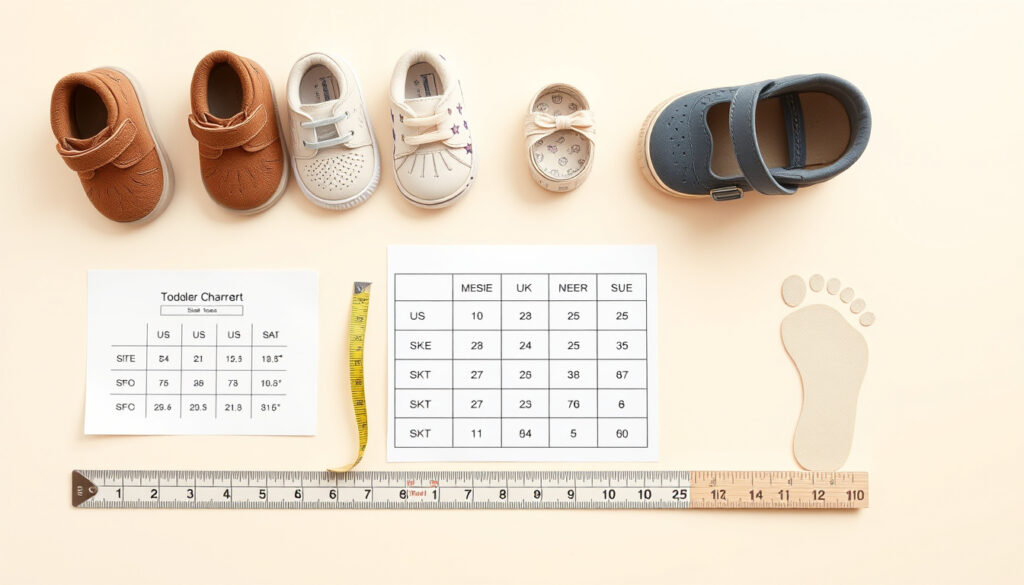
Toddler Shoe Size Chart by Age: US, UK, EU Sizes & How to Measure
Few things feel trickier than figuring out your toddler’s shoe size when a single label can mean something different from brand to brand. If you’ve ever held up a size 6 shoe next to your child’s foot and wondered whether it’s too big, too small, or just right, you’re not alone. This guide breaks down US, UK, and EU sizing for toddlers ages 1–4, with a practical measuring method that takes the guesswork out of the process.
Toddler shoe sizes (US) typically range from 4 to 10: US 4–10 ·
Average foot length for 2-year-old child: 5.5–6 inches (14–15.2 cm) ·
Average foot length for 3-year-old child: 6.1–6.5 inches (15.5–16.5 cm)
Quick snapshot
Age 1 (12–18 months)
- US size: 4–5 (Kids Foot Locker)
- EU size: 20–22 (Kids Foot Locker)
- Foot length: 11.5–12.7 cm (Kids Foot Locker)
Age 2 (18–24 months)
- US size: 5–6 (Kids Foot Locker)
- EU size: 22–24 (Kids Foot Locker)
- Foot length: 12.7–14 cm (Kids Foot Locker)
Age 3 (2–3 years)
- US size: 7–8 (Kids Foot Locker)
- EU size: 24–26 (Kids Foot Locker)
- Foot length: 14.5–16 cm (Kids Foot Locker)
Age 4 (3–4 years)
- US size: 8–10 (Kids Foot Locker)
- EU size: 25–27 (Kids Foot Locker)
- Foot length: 15.5–17 cm (Kids Foot Locker)
Six quick facts that anchor every decision when buying toddler shoes, drawn from major children’s footwear authorities.
| Label | Value |
|---|---|
| US toddler size range | 4–10 |
| Average foot length at age 2 | 14–15.2 cm |
| Average foot length at age 3 | 15.5–16.5 cm |
| UK size for 3-year-old | 6–7 |
| EU size for 2-year-old | 22–24 |
| Growing room to allow | 0.5–1 cm (thumb width) |
What shoe size fits a 2-year-old and a 3-year-old?
Average foot length for 2-year-olds
By the second birthday, most toddlers have feet measuring between 5.5 and 6 inches (14–15.2 cm). That range comes from the New Balance kids size guide (athletic footwear specialist), which includes conversion tables based on measured foot length.
The implication: a 2-year-old’s foot is already more than halfway to the average adult foot length, so growth spurts can feel sudden.
Common shoe sizes for 2-year-olds in US, UK, EU
US size 5 or 6 is typical for this age, according to Kids Foot Locker age-based guide (specialist children’s footwear retailer). In UK sizing, that translates roughly to size 5–6; in EU, aim for 22–24. But Shoe Zone (UK high-street shoe retailer) notes that brand variation means the same age can land on different numbers, which is why they recommend measuring rather than guessing.
Average foot length for 3-year-olds
By age three, the foot typically lengthens to 6.1–6.5 inches (15.5–16.5 cm). That figure aligns with the Nordstrom size guide (department store with extensive kids’ footwear range), which segments toddler shoes for ages 2–4.
Common shoe sizes for 3-year-olds in US, UK, EU
US size 7 or 8 is the sweet spot for most three-year-olds. Carter’s (specialist children’s apparel and footwear brand) confirms that their toddler sizes 7–8 align with this age group. The UK equivalent is size 6–7; EU size 24–26 covers the range. The Start-Rite size calculator (children’s shoe specialist with width fittings) emphasises that using foot length in millimetres gives a far more reliable fit than age alone.
The implication: measuring the foot removes the guesswork that age-based charts leave behind.
Is a 12C a toddler shoe? Understanding toddler versus little kid sizing
What does ‘C’ mean in kids’ shoe sizes?
In US sizing, the letter C stands for “child” or “toddler.” Kids Foot Locker states that toddler sizes are 4–10, and size 12C falls within that band—so yes, 12C is a toddler size. The Carter’s guide adds that some brands label toddler sizes with a T (e.g., 10T) instead of C, but the fit is essentially identical.
Toddler size range vs. preschool/grade school
The line between toddler and preschool sizes is a common source of confusion. Kids Foot Locker lays it out clearly: infantil sizes run 1–3, toddler sizes 4–10, preschool (little kid) starts at 10.5 and goes to 3, and grade school begins at 3.5. So a size 12C—which is actually a toddler size—is often the largest toddler option before a child moves to the preschool scale.
Is 10 toddler the same as 10C?
Generally yes, but not always. Most brands treat “10 toddler” and “10C” as the same fit. However, Carter’s notes that a few manufacturers differentiate between toddler and little kid 10, labelling the little-kid version as 10Y or 10 Big Kid. When in doubt, measure the foot length and match it to the brand’s chart rather than relying on the C label alone.
The pattern: brand variation makes measuring essential for a proper fit.
What age child fits a size 4 shoe?
Age range for size 4 toddler shoes
US size 4 is the smallest toddler size and typically fits babies around 12–18 months old, just as they start walking. Kids Foot Locker age guide maps size 4 to the 12–18 month window, and the Nordstrom PDF similarly shows size 4 aligning with 1-year-olds.
Matching age to shoe size in US, UK, EU
In the UK, size 4 translates to EU 20–21 and a foot length of roughly 4.75 inches (12 cm), according to Shoe Zone’s conversion chart. The Next conversion chart (UK clothing retailer with international sizing) confirms the same EU equivalent.
The pattern: size 4 is the entry point for toddler footwear, and parents should expect to size up every 3–4 months during this rapid growth phase.
How to measure a toddler’s foot for accurate shoe sizing
-
Step 1: Trace the foot on paper
Shoe Zone’s measuring guide instructs: tape a sheet of paper to the floor against a wall, place the child’s foot on it with weight evenly distributed, and mark behind the heel and in front of the longest toe. Carter’s adds that the child should be standing upright—sitting or lying gives a smaller measurement.
-
Step 2: Measure length from heel to longest toe
Use a ruler or flexible tape measure to record the distance between the two marks. New Balance recommends measuring both feet and using the longer one, as most people have one foot slightly larger than the other.
-
Step 3: Add 0.5–1 cm for growing room
Leave a thumb’s width—roughly 0.5–1 cm—between the longest toe and the end of the shoe. Carter’s notes that this allowance works for most closed shoes, but for sandals and flip-flops, a tight fit is better to prevent tripping.
-
Step 4: Match measurement to size chart
Compare your measurement (in cm or inches) against the brand’s size chart. Start-Rite offers a home size calculator that takes the measurement and suggests the correct UK and EU size, including width fittings from D to H. Kids Foot Locker chart also maps foot length directly to US, UK, and EU sizes.
Parents who measure both feet and allow growing room avoid the cycle of buying shoes that are either too tight (causing blisters) or too loose (causing falls). Shoe Zone and Start-Rite both offer free measuring services in stores if you’d rather not do it at home.
The catch: toddler feet grow fastest between ages 1 and 3, so a pair bought today may be snug in three months. Re-measure every 8–10 weeks during this window.
Toddler shoe size chart by age in cm and EU: a quick reference
Seven US toddler sizes, each with a consistent pattern: the foot grows roughly 0.7–0.8 cm per size step. The table below compiles data from Shoe Zone, New Balance, and Kids Foot Locker.
| US toddler size | Foot length (cm) | EU size | UK size |
|---|---|---|---|
| 4 | 12.0 | 20–21 | 4 |
| 5 | 12.7 | 21–22 | 5 |
| 6 | 13.5 | 22–23 | 6 |
| 7 | 14.3 | 23–24 | 7 |
| 8 | 15.0 | 24–25 | 8 |
| 9 | 15.8 | 25–26 | 9 |
| 10 | 16.5 | 26–27 | 10 |
The pattern: US sizes 4–10 track almost linearly with foot length, and the EU equivalent consistently lands two numbers higher (e.g., US 7 → EU 23–24). Girls and boys in the same age range share very similar foot lengths, so no separate gender chart is needed.
Brands like Nike and Adidas sometimes label their toddler sizes as 4C, 5C, etc. That C confirms it’s a toddler size, but the actual fit can run half a size larger or smaller than the same number in a non-sport brand. Always check the specific label.
The pattern: using foot length rather than age or the C label gives the most reliable fit.
What’s confirmed and what’s still unclear about toddler shoe sizing
Confirmed facts
- US toddler sizes 4–10 correspond to ages ~1–4 years (Kids Foot Locker).
- Size 12C is a toddler size in most brands (Carter’s).
- Foot length measurement is more reliable than age for sizing (New Balance).
- Allow a thumb-width of growing room (Shoe Zone).
What’s unclear
- Exact age-size mapping varies by brand and individual growth rate (Nordstrom acknowledges a 2–4 year span for toddler sizes).
- When a child transitions from toddler to little kid sizing can differ by up to half a size (Start-Rite offers width fittings to bridge the gap).
- Some brands may label 10C and toddler 10 differently; check the specific chart.
The implication: always rely on measurement rather than guesswork.
Expert perspectives on fitting toddlers’ shoes
“Measuring foot length and allowing growing room is the single most important step. Age-based charts are a starting point, but every child’s growth curve is different.”
Kids Foot Locker size guide (specialist children’s footwear retailer)
“We recommend buying the size that fits the larger foot if the child’s feet differ in length. A tiny bit of room for growth helps, except for sandals and flip-flops.”
Carter’s baby, toddler, kid shoe sizes guide (children’s apparel and footwear brand)
The catch: toddler feet grow fastest between ages 1 and 3, so a pair bought today may be snug in three months. Re-measure every 8–10 weeks during this window.
For UK and EU parents, the choice is clear: use a home measuring method (paper trace + ruler) and match the centimetre length to a brand’s chart rather than relying on age or the “C” label. Shoe Zone, Start-Rite, and Next all offer free printable conversion tables that remove the guesswork. Buy for the larger foot, leave a thumb’s width of room, and check fit every two months—or your toddler could be walking in shoes that pinch without anyone realising.
The pattern: consistent measuring habits prevent fitting mistakes.
Related reading: Carter’s baby, toddler, kid shoe sizes guide · Kids Foot Locker shoe size guide
For a detailed breakdown of toddler sizing, the toddler shoe size chart by age provides measurements in centimeters alongside US, UK, and EU conversions.
Frequently asked questions
How often should I measure my toddler’s feet?
Every 8–10 weeks during the first three years. Start-Rite recommends measuring at home before each new shoe purchase, as growth spurts can be unpredictable.
Should I buy leather or synthetic shoes for toddlers?
Leather is generally more breathable and moulds to the foot, but synthetic options are often lighter and easier to clean. Shoe Zone offers both materials and suggests letting the child’s comfort guide the choice.
Do toddler shoe sizes differ between boys and girls?
Not significantly. New Balance uses the same size chart for both boys and girls up to size 10; differences become more pronounced in grade school.
Can I use a printable shoe size chart at home?
Yes. Next and Shoe Zone both provide printable charts. Print at 100% scale and follow the instructions for accurate results.
What if my toddler’s feet are slightly different sizes?
Buy for the larger foot. Carter’s advises that a half-size difference is common and shouldn’t be ignored—the larger foot determines the fit.
Are Crocs toddler sizes the same as US standard?
Crocs use their own sizing system. It’s recommended to consult Crocs’ official size chart before buying, as their toddler sizes may run larger or smaller than standard US sizing.
What does C12 mean in kids’ shoe sizes?
C12 stands for “Child size 12.” It’s a toddler size in US footwear. Kids Foot Locker confirms that 12C falls within the toddler range (4–10), though some brands list it as a preschool size.
More related posts
 First Home Buyers Grant – Complete Guide by State
 Dawn Service Anzac Day: History, Timing & What to Expect
 Warhammer 40,000: Tabletop Guide, Games & Movie News
 Mitsubishi Heat Pump Symbols – Error Codes, Status and Fixes
 Business Loan Calculator NZ: Compare Top Repayments & Rates
 Denver Nuggets vs Phoenix Suns Match Player Stats – Box Scores
 When Did PS4 Come Out? Release Dates, Lifespan & 2026 Status
